

Let me paint a picture that might feel familiar.
A potential customer finds your brand. They're interested, so maybe they send a DM, maybe they use the chat on your website, maybe they email in with a question. Your team sees it. Someone means to follow up. But there's no process that says who owns it, when to respond, or what to say. So it sits. And then it disappears.
That person didn't stop wanting what you sell. They just stopped waiting.
That's what an unstructured workflow actually looks like. Not chaos you can see, but chaos you feel. In the leads that never converted. In the revenue that never showed up on a report because it never had the chance to. In the fact that every time you step away, something falls through.
"The absence of a workflow isn't neutral. It's a daily tax on your revenue, your team, and your time."
Does Any of This Sound Like Your Brand?
Unstructured workflows don't always announce themselves. Sometimes they hide behind words like "we're still figuring it out" or "that's just how we operate right now." Here are the real signs:
Your team comes to you with questions that should already have answers — because those answers only live in your head, not in a documented process.
You approved a return, a discount, or an exception this week not because it was the right call, but because it was easier than explaining the policy that doesn't exist yet.
You question whether you're spending money on the right processes because the brand isn’t growing.
Two customers had the same issue this month and got two different responses depending on who picked up the ticket.
You've had the same operational problem more than once. Different week, same fire, same scramble to fix it.
The thought of taking a real vacation fully offline, fully disconnected — genuinely makes you anxious, because you know things would fall apart without you.
Every time you think about scaling, your stomach drops a little. Because you know more orders just means more of this.
If you read even two of those and thought, "Yes, that's us," your brand is running on you. Not on a system. And that distinction is everything.
Here's What it's Actually Costing You:
This is the part most brand owners skip. They feel the stress of unstructured operations, but they never sit down and count the cost. So let's count it.
Every unstructured touchpoint in your business is a place where money, time, or trust is leaking. These aren't dramatic failures; they're quiet, daily losses that compound month over month without ever showing up cleanly on a report.
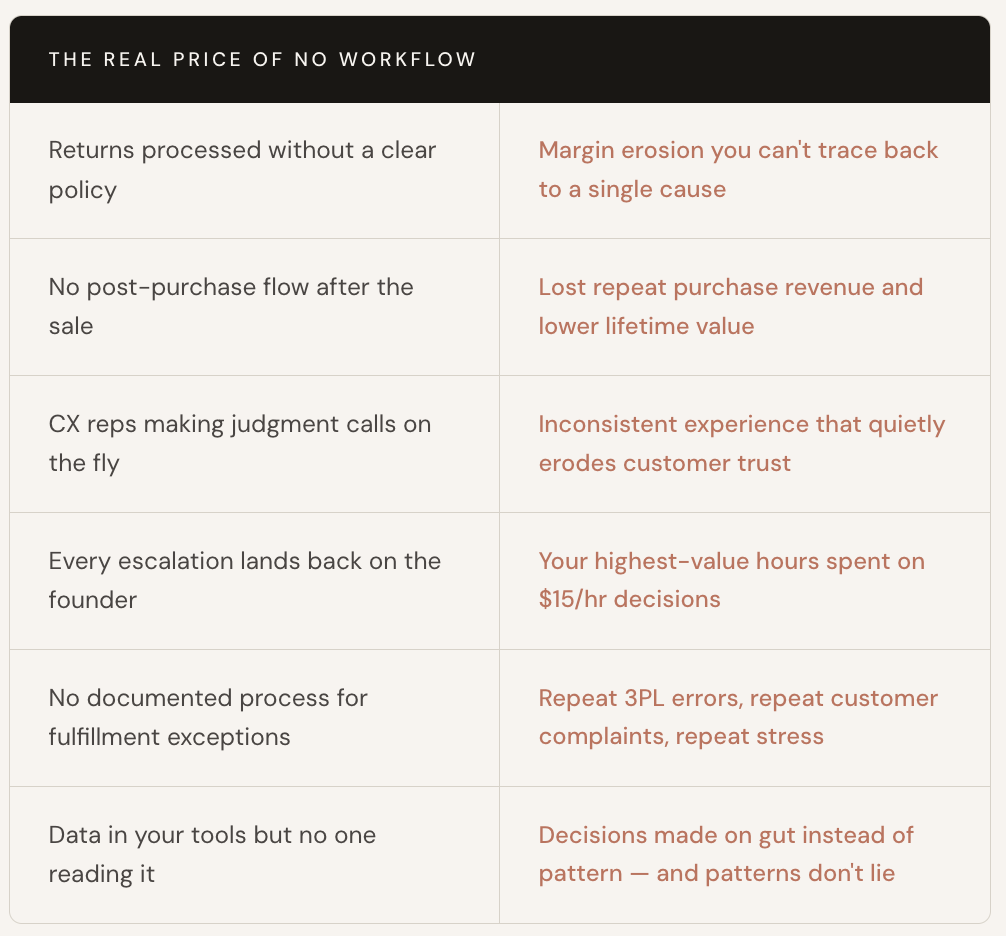
A brand doing two million dollars in revenue with unstructured workflows isn't just a stressed founder. It's a business leaving real money on the table every single month without a single line item to show for it.
The Myth That Keeps Brands Stuck:
Here's what I hear most often from brand owners who are deep in this: "I just need to hire someone."
And sometimes that's true. But more often, what they actually need is a system to hire into. Because bringing a new person into an unstructured operation doesn't fix the operation, it just gives the chaos one more set of hands to manage it.
The brands that scale cleanly are not the ones with the biggest teams. They're the ones where every person on the team knows exactly what to do, who owns what, and what good looks like… without asking the founder first.
That clarity doesn't come from talent alone. It comes from structure.
"You don't need more people in the chaos. You need to build the system that makes the chaos stop."
What Changes When Structure is in Place:
In one of my previous roles, leads were coming in every single day through email, through the website's AI chat, through social media DMs, and comments. They were people who were asking questions, nearly ready to buy, past customers who just needed one more touchpoint to come back.
None of it was being captured. Not because the brand didn't care but because there was no system to catch it. Every inquiry that didn't convert immediately just disappeared into the noise.
The first thing I did wasn't complicated. I opened ClickUp, created a task, and started a Google Doc. Every lead got logged with their name, which channel they came through, how they heard about the brand, and whether they placed an order after I spoke with them. And then the detail that made everything else possible: notes. Specific, human notes: this person is price sensitive, this one is looking for a discount, this one mentioned they saw us on Instagram, and this one asked about a specific style twice.
That wasn't data entry. That was behavioral intelligence built manually, one lead at a time. From there, I brought those leads into Klaviyo and placed them into segments based on exactly those notes, where they were in their journey, what they were sensitive to, and what they needed to hear next.
The result was a CRM and retention system that generated approximately 10% of total company revenue, built almost entirely from people who were already raising their hands. They just needed someone to build the structure to catch them, understand them, and follow up with intention.
That is what structure does. It stops letting warm opportunities go cold. It turns the signals your brand is already receiving through every email, every chat message, every DM into a system that works for you instead of disappearing into an inbox nobody owns.
The First Step is Seeing Where it's Leaking
Most brand owners know something is off. They can feel it in the friction, the fires, the ceiling they keep hitting. What they don't always have is a clear picture of exactly where the operation is losing them and what to prioritize first.
That's the starting point. Not a full systems overhaul on day one. Just clarity. A real look at where your workflows are working, where they're not, and what it's costing you to leave them unstructured.
Once you can see it, you can fix it. And once it's fixed, it runs without you in the middle of everything, all the time.
Your brand deserves an operation that matches what you've built. The question is just whether you're ready to stop absorbing the cost of not having one.

If you're ready to stop managing chaos from your head, I can help you build a system that actually fits how you think and work.
Whether you're a solo creator, a consultant, or a growing brand, I’ll work with you to design an Ops or CX setup that brings clarity, reduces overwhelm, & gets your energy moving in the right direction.
